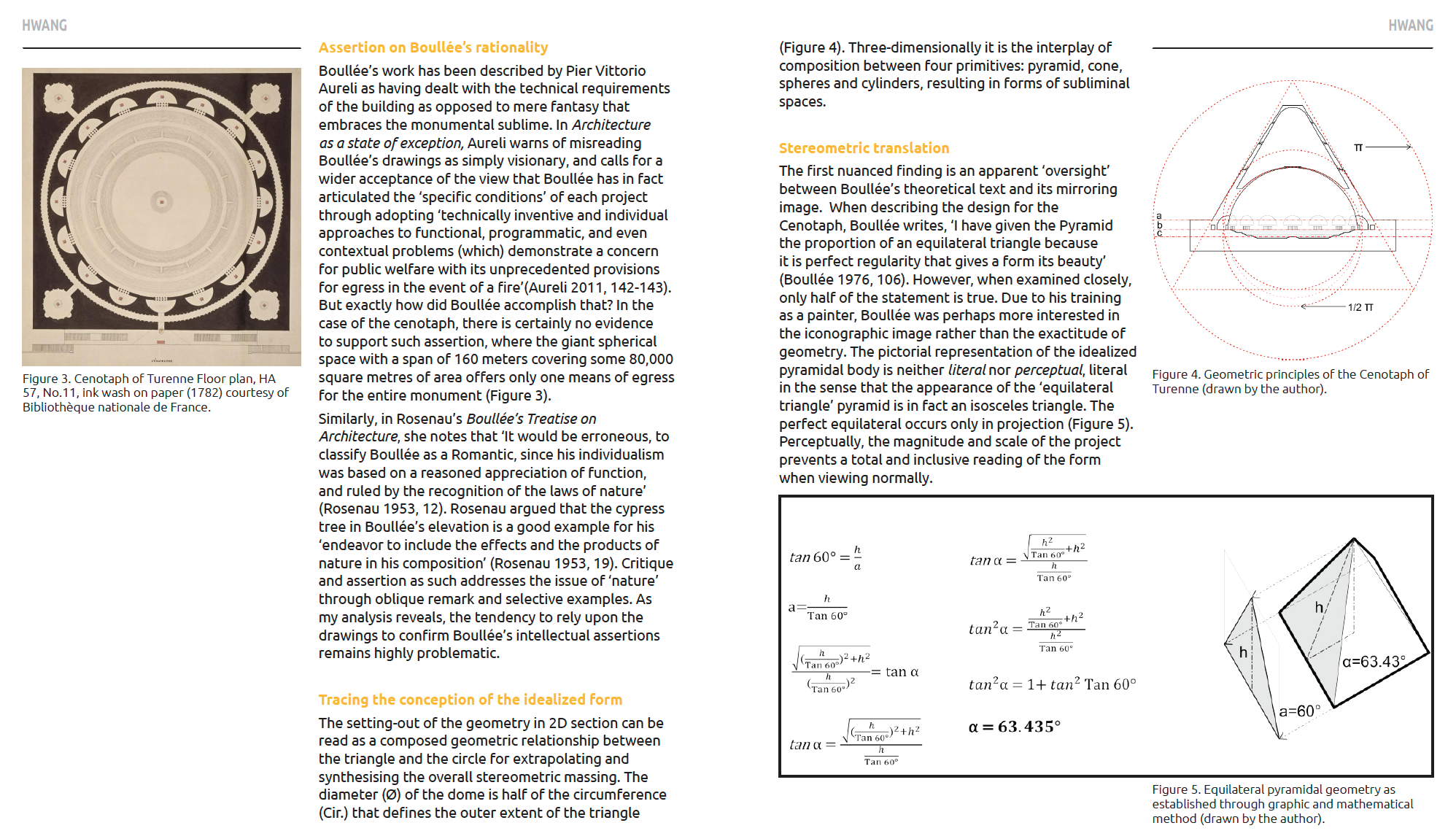
Evaluating the rationality of Boullée through the chasm between conception and perception using digital modelling as a method of analysis: a case study on the Cenotaph of Turenne
Between 1780 and 1797 French architect Etienne-Louis Boullée began projecting a vision of the architectural monuments during his twilight years through the use of ink-wash drawings on hot-pressed straw paper. The visionary projects embrace both formal simplicity and expressivity simultaneously. While simplicity of form was believed to be the key for ease of apprehending the work, expressivity was seen as necessary to convey the meaning of the form itself. This research presents a study of one particular project produced during this period: the Cenotaph of Turenne 1782, by reconstructing and analysing the unbuilt paper architecture through physical and digital modelling. It seeks to provide an alternative frame of reference to the discourse that evaluates the metaphoric or the iconographic aspects of Boullée’s project. The goal of this study is to unfold the stereometric forms and examine the reciprocal relationship between the project’s conceptual intention as conceived by Boullée with the effect of the spaces as perceived by the viewer. The paper proposes to investigate Boullée’s Cenotaph through the chasm between the concept of the work and its representative images, the apparent and the literal solidity of structure, and the idealized form and the perceived form by the viewer. The research is organized in two parts. The first part aim to forensically deconstruct the guiding principles of Boullée’s Cenotaph in order to reveal how the Cenotaph is conceived, while second part enable the reading of how the work is perceived. Although the project is well-publicized in books on Boullée through the five known orthographic drawings, very little has been written about it.